Gold
Silver
Platinum
Palladium
·Updated every 60s
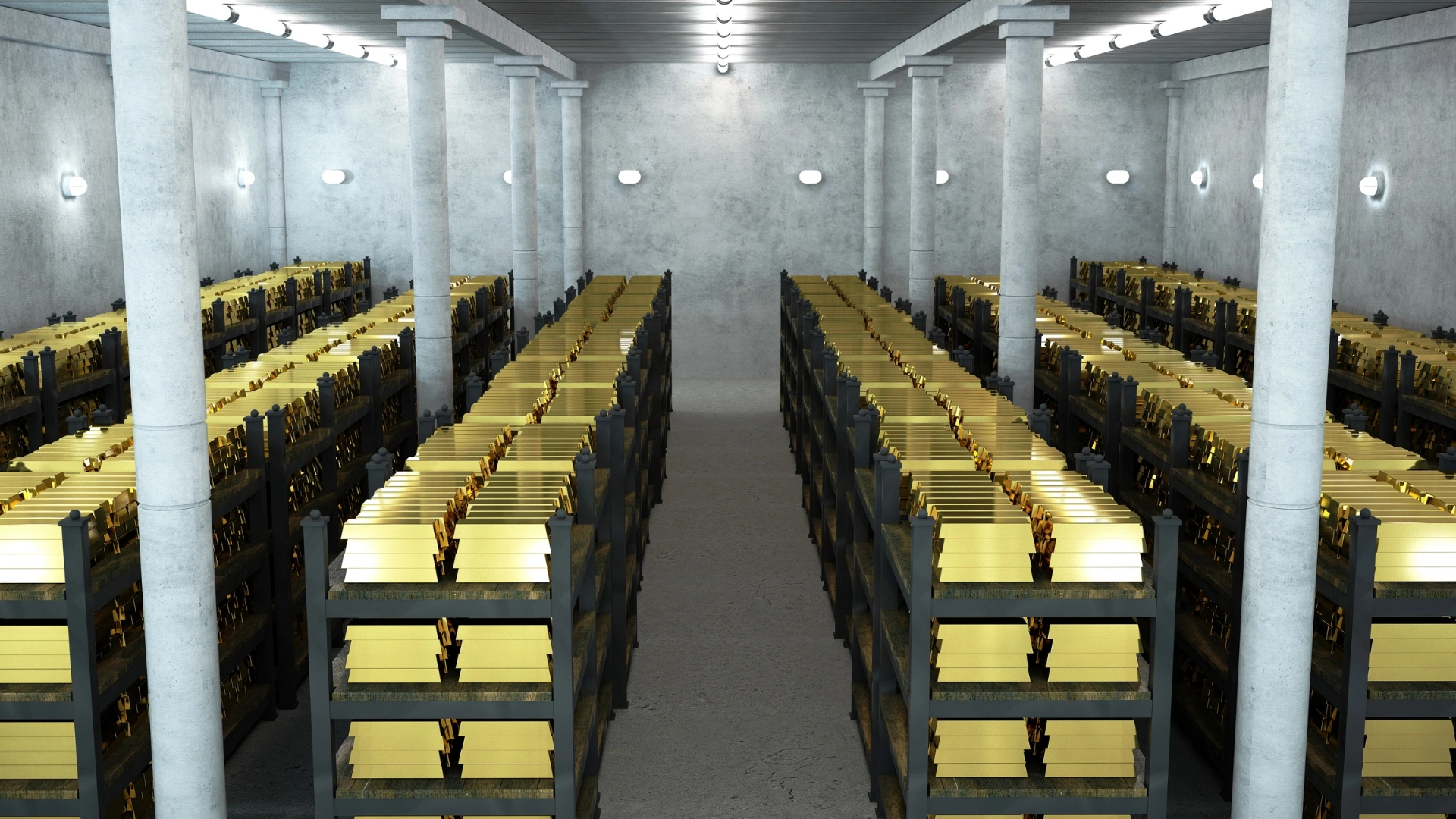
The complete guide to America's legendary gold vault — updated February 2026
Quick Answer
147.3M
troy ounces
4,580
metric tons
$736.7B+
at current prices
Edit the price above to model different scenarios, or leave it to use the live market rate.
Total Fort Knox Value
$736,709,290,000
147,341,858 oz × $5,000
Value per American
$2,199
Based on 335,000,000 population
% of U.S. National Debt
2.05%
Of $36 trillion debt
The U.S. government still values Fort Knox gold at $42.22 per ounce — a price set by the Par Value Modification Act of 1973.
Based on $42.22/oz — set in 1973
Based on ~$5,000/oz — February 2026
Source: U.S. Treasury Fiscal Data
The United States Bullion Depository — commonly known as Fort Knox — is a fortified vault building on the grounds of Fort Knox, a U.S. Army installation in Kentucky. Constructed in 1936 and receiving its first gold shipments in January 1937, the depository was built to store the nation's rapidly growing gold reserves during the Great Depression era.
Named after Henry Knox, the first U.S. Secretary of War and a key figure in the American Revolution, the depository was designed by architect Louis A. Simon in a stripped neoclassical style. The building itself is relatively modest in size — just 105 feet by 121 feet — but what it lacks in footprint, it makes up for in sheer impregnability.
39 trains. 215 rail cars. 5 months.
Soldiers with machine guns guarded every shipment of gold to the newly built depository.
As of February 2026, Fort Knox holds 147,341,858 troy ounces of gold — roughly 4,580 metric tons. This represents about 56% of the total U.S. gold reserves, which are spread across multiple facilities.
Standard Gold Bar Specs
Dimensions
7" × 3.625" × 1.75"
Weight
~27.5 lbs (400 troy oz)
The NY Fed vault holds 6,000+ tons total, but most belongs to foreign governments.
Source: U.S. Mint (usmint.gov)
A single U.S. vault holds more gold than any other entire country's reserves.
Source: World Gold Council, February 2026
The U.S. Bullion Depository is one of the most impenetrable structures ever built.
21 inches thick, weighs 20 tons, torch-and-drill resistant
100-hour time lock mechanism
No single person knows the full procedure to open
Night-vision cameras and microphones across the perimeter
Adjacent to an active U.S. Army installation
16,000 cubic feet of granite, 750 tons of reinforcing steel
1941–1944
Declaration of Independence, U.S. Constitution, Bill of Rights
WWII era
Gutenberg Bible, Lincoln's Gettysburg Address
1940s–1978
Hungarian Crown Jewels (crown, sword, scepter, orb, cape of St. Stephen)
1940s
One of four surviving copies of the Magna Carta
1955–1993
Opium and morphine stockpile (enough to supply the entire U.S. for one year)
Today
Ten 1933 Double Eagle gold coins, a 1974-D aluminum cent, twelve gold Sacagawea dollars that flew on Space Shuttle Columbia
Last full public audit
First civilian inspection (journalists + Congressional delegation). Treasury Secretary William Simon authorized it to quiet rumors.
Treasury Secretary Steve Mnuchin visits with Senate Majority Leader Mitch McConnell. Tweets: "Glad gold is safe!"
President Trump and Elon Musk call for a full audit. Rep. Thomas Massie introduces the "Gold Reserve Transparency Act" requiring independent physical audits every five years.
Treasury Secretary Scott Bessent says "all the gold is present and accounted for." No video inspection has been released. At $5,000+/oz, the stakes are higher than ever.
The last full physical audit of Fort Knox was in 1953 — over 70 years ago. An independent audit would require an estimated 18–24 months and 44,400 man-hours.
James Bond film featuring a plot to irradiate Fort Knox's gold
Comedy partially filmed at Fort Knox
Bugs Bunny and Yosemite Sam dig for Fort Knox gold
The phrase "as safe as Fort Knox" entered the American vocabulary
For most of the 20th century, the U.S. dollar was directly convertible to gold. Under the Bretton Woods system established in 1944, foreign governments could exchange dollars for gold at a fixed rate of $35 per ounce. This arrangement required the United States to hold massive gold reserves to back its currency — and Fort Knox was the centerpiece of that system.
In 1971, President Nixon ended dollar-to-gold convertibility, effectively taking the United States off the gold standard. But the gold never left. As former Federal Reserve Chairman Alan Greenspan once put it, the U.S. holds gold reserves "just in case we need it."
That reasoning has proven prescient. Central banks worldwide have been buying gold at record rates — China added gold to its reserves for 15 consecutive months through January 2026. Gold remains the ultimate confidence asset: a physical store of value that underpins trust in the U.S. dollar and the global financial system.
Approximate market value of Fort Knox gold reserves, 2000–2026
Sources: U.S. Mint, Federal Reserve Bank of St. Louis (FRED), World Gold Council
Whether you're buying or selling, our experts provide fair evaluations and same-day payment on gold, silver, and rare coins.